Traffic Down, Rankings Stable? Here's What's Really Happening
June 1, 2026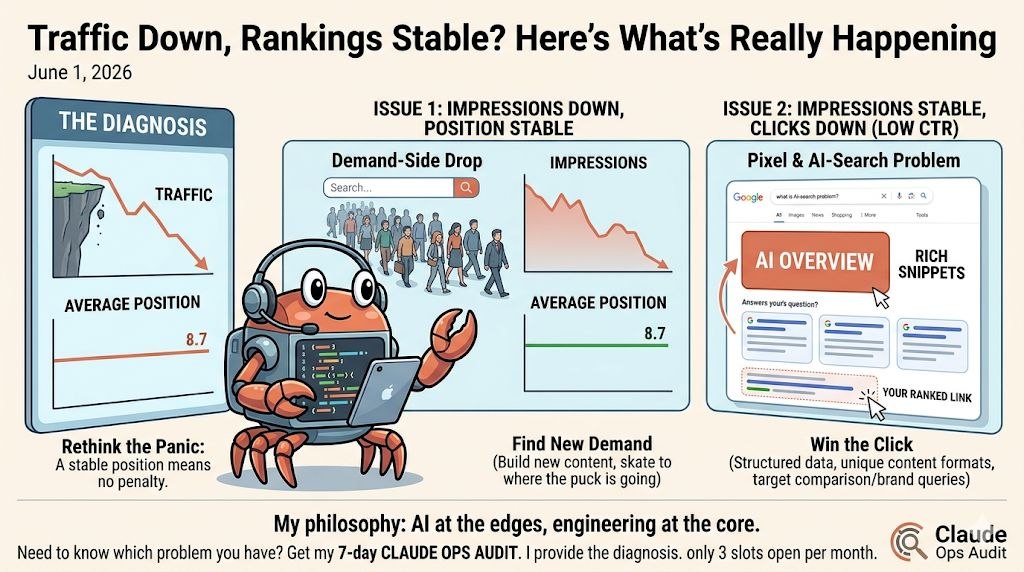
You check analytics. The traffic chart fell off a cliff. The instant panic is that Google penalised you. You're probably already drafting pages to delete and links to disavow.
Stop. Don't tear the site apart yet. Two completely different issues cause this exact drop, and confusing them wastes weeks of work.
Open Google Search Console. Forget GA4. The answer is usually hiding in the gap between impressions and average position.
I saw this on a recent project. Monthly traffic collapsed, but average position held rock-steady at 8.7. Impressions simply cratered from 500 a day down to 110. The rankings didn't change, but the search volume did.
This wasn't a penalty. A penalty drops your ranking positions. When positions hold but impressions fall, the search volume itself has dried up. People are no longer searching for those terms, and tinkering with on-page SEO won't bring them back.
There is a second, worse issue: the pixel problem. In my project's data, the site-wide CTR was a tiny 0.11% on 9,500 impressions. Even when people search, Google’s AI Overviews and rich snippets answer the query directly on the SERP. You get the impression, but the user never clicks through to your site.
Diagnosing your specific issue is straightforward.
- Impressions down, position stable: Demand-side drop. The audience is searching for something else, or using different terms. Your site is fine; the market moved.
- Impressions stable, clicks down: Pixel and AI-search problem. You are visible but get ignored because Google answers the query on the search page.
Each diagnosis demands completely different work.
For demand-side drops, do not rewrite existing pages. You need to find the new demand. Find out what your audience is searching for now and target those growing, adjacent topics. Skate where the puck is going.
If you have a pixel and AI problem, the battle is for the click. Analyze the search results for your primary terms. You must structure your schema to win rich snippets or pivot to topics AI cannot easily summarize, like hands-on comparisons or specialized tools. Video and downloadable files are harder for scrapers to swallow.
Diagnose first, then build. Assuming you were penalised when rankings are stable is a costly mistake. It leads to weeks of panicked code changes that achieve nothing. Search Console tells you the truth in ten minutes.
My core philosophy is AI at the edges, engineering at the core. I use tools like Claude to separate the signal from the noise, but I back it up with real engineering. That means querying the APIs directly, structuring data properly, and building fixes based on actual data.
If your traffic chart is tanking and you need to know why, I can help you diagnose it. I'll dive into your Google Search Console data, find the exact bottleneck, and build a clear plan to fix it.
→ View my SEO services or get in touch
Is your store leaking SEO traffic?
Enter your URL and email below. I will run a deep-dive technical SEO scan on your site and email you a free, actionable PDF report. No developer console required.