Rank Is Dead: Why Your Google Rankings No Longer Equal Traffic
June 1, 2026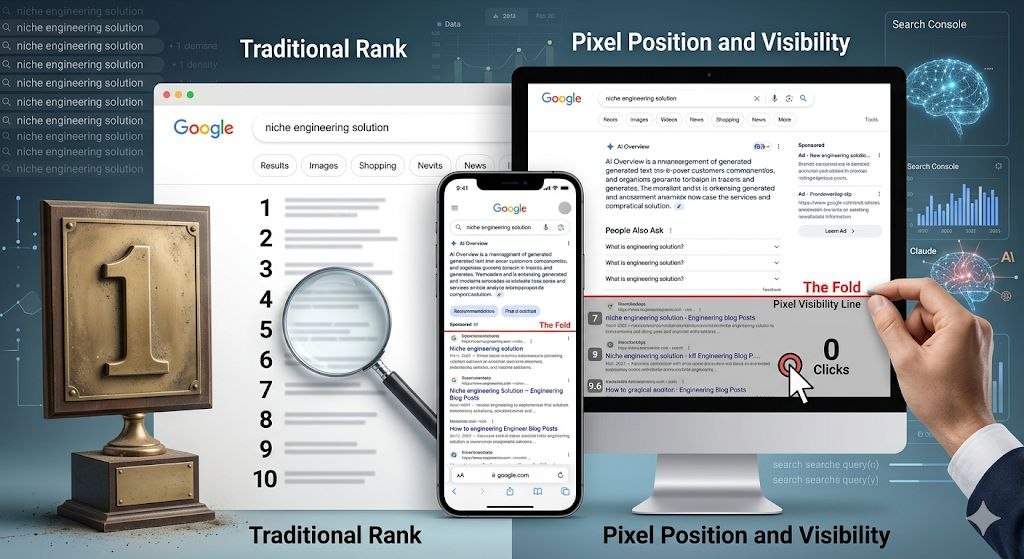
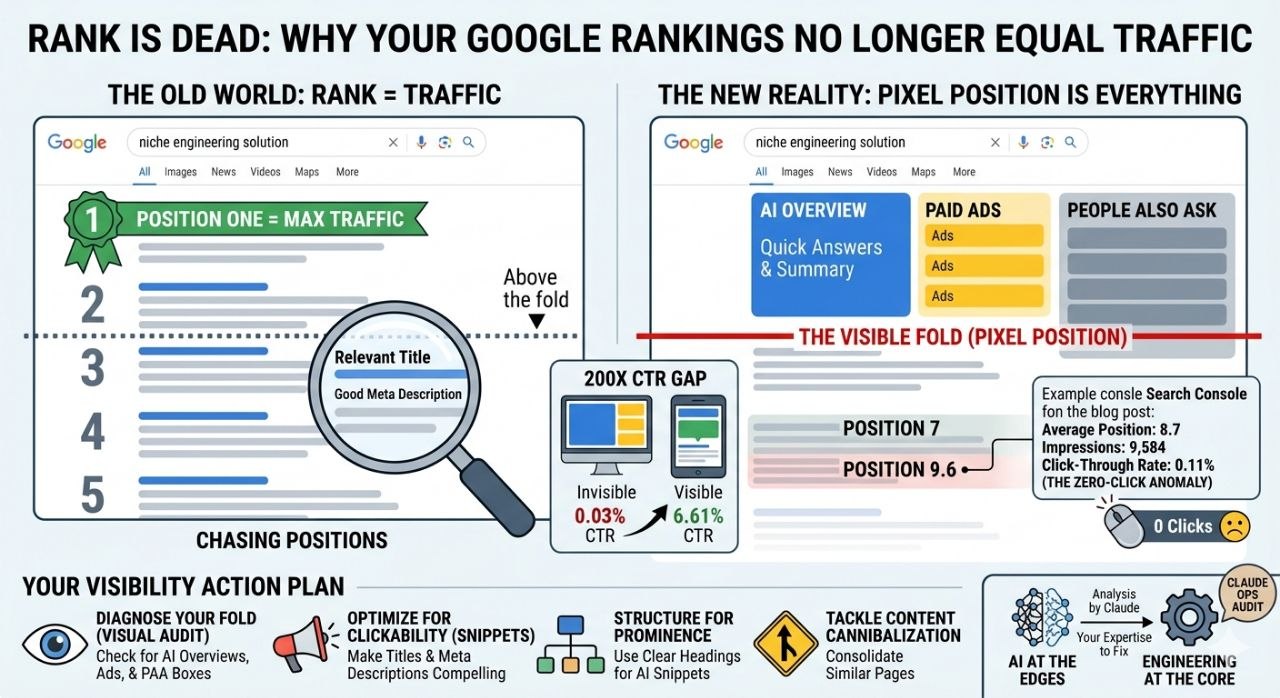
My blog post on a niche engineering topic recently sat at position ~7 in Google search results for a really relevant keyword. Seven. Not bad, right? I pulled the Google Search Console data for the last 28 days: ~1,000 impressions. Impressive. You know how many clicks that got? Zero. Not one. Another post, hovering around position ~9.6, pulled in 1,434 impressions, also with zero clicks.
Across the entire site, I saw 9,584 impressions with an average position of 8.7 — by traditional SEO metrics, that's pretty healthy. But the click-through rate? A paltry 0.11%. The system was broken. It wasn't my rankings. My content was getting seen by Google, but not by humans.
The old world of SEO taught us that ranking on page one meant traffic. We chased position one, or at least the top five, because that's where people looked. But today's Search Engine Results Page (SERP) is much different. It's filled with AI Overviews, paid ads, and People Also Ask sections. These elements compete for the visible area at the top of the screen. Google might rank your content at position 7, but that "position" often means it's three scrolls deep, below many other elements. Rank shows where Google files your content. Pixel position shows whether a human actually sees it.
The stark reality of this new landscape hit me when I broke down my Search Console data by device. My desktop impressions were massive: 9,463. But the CTR for desktop was a dismal 0.03%. Then I looked at mobile. Just 121 impressions, but a phenomenal 6.61% CTR – at an even worse average position than desktop. Same site, same content, a 200x CTR gap. Rank alone couldn’t explain that anomaly. Pixel position, however, could. On desktop, my "healthy" position 7 result was simply invisible, buried under an AI Overview, a carousel of ads, and a few rich snippets. On mobile, where the SERP is often tighter and more focused, those same results might have appeared just above the fold, or immediately after a less intrusive AI snippet.
So, if traditional rank is no longer the only factor for visibility, what do we do? This isn't about chasing algorithms; it's about understanding how users behave on a busy screen.
You need to diagnose where your real fold falls. Don't guess. Use tools or manual checks for your target keywords to see what users actually see. Are there AI Overviews? How many ads? Do People Also Ask boxes dominate the view? This visual audit reveals the true pixel position of your "ranked" content.
Next, focus on optimising your titles and meta descriptions. These should be designed for clickability, not just keywords. If your content does appear, even if it's below an AI Overview, it needs to be compelling enough to encourage a scroll and a click. Think about sparking curiosity, conveying urgency, or directly solving a problem. Make your snippet stand out.
You also need to strategically structure your content to gain prominence at the top of the screen. If Google is pulling AI Overviews for quick answers, ensure your content provides clear, concise answers upfront. Use explicit question headings. This isn't just about SEO; it improves user experience. Break down complex topics into digestible sections that Google's AI can easily interpret and feature.
Finally, tackle content cannibalization. If you have multiple pages targeting similar keywords, they might compete with each other and confuse Google. This ultimately pushes both down. Consolidate, repurpose, or differentiate these pages. Ensure each one has a distinct purpose. The strongest page then has the maximum chance of ranking and gaining pixel position.
This isn't about discarding everything you know about SEO. It’s about adapting. This diagnosis — spotting the zero-click anomaly, understanding the 200x CTR gap, and identifying the root cause in pixel position — was AI-at-the-edges. I used Claude to sift through my GSC data, identify the patterns, and surface the core problem quickly. The solution, the engineering to fix it, comes from my core expertise: diving into the site, rewriting the snippets, re-architecting the content structure. It’s "AI at the edges, engineering at the core" in action. It’s how I work.
If your rankings look good but your traffic is low, you're probably suffering from pixel invisibility. I offer a technical SEO audit to find where your site is getting buried. If you want me to look at your Search Console data and map out a clear fix list, get in touch and I'll take a look.
→ View my SEO services or get in touch
Is your store leaking SEO traffic?
Enter your URL and email below. I will run a deep-dive technical SEO scan on your site and email you a free, actionable PDF report. No developer console required.